
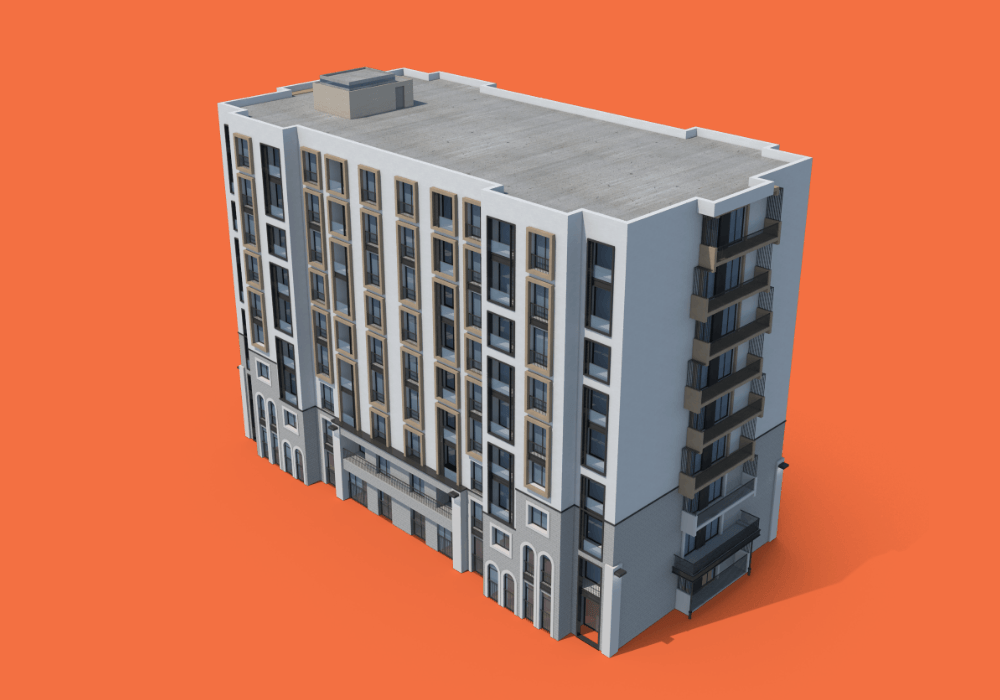
Every building project starts with one question: Do we actually know what exists today?
For architects, developers commercial landlords and many other property professionals, decisions are often made using existing drawings that may be years old, incomplete or no longer reflect the current building layout.
That creates risk before design has even begun.
Traditionally, measured surveys have delivered 2D outputs such as floor plans, elevations and sections. These remain an essential part of the design process and continue to support planning applications, lease documentation, refurbishment and development projects.
But increasingly, clients are asking for something more.
They want a building they can explore, interrogate and design around before stepping on site.
That is where 3D Revit models are becoming part of the conversation.
What is Revit — and Why Was It Introduced?
Many people know Revit as 3D modelling software, but its purpose goes beyond creating a visual model.
The name Revit is widely understood to originate from “Revise Instantly” — reflecting one of the software’s biggest advantages: when information is updated in one location, associated views and outputs update together across the project.
Revit was introduced to move the industry beyond traditional disconnected drawing workflows.
Historically, architects, engineers and project teams often worked across separate drawings and documents. A design change made in one location could require manual updates across plans, sections and elevations, creating opportunities for inconsistency and coordination issues.
Revit introduced a more connected approach.
Rather than treating drawings as individual files, the model becomes a shared source of building information that different disciplines can reference and develop.
This supports improved collaboration between:
- Architects developing layouts and spatial design
- Engineers coordinating structural and building services requirements
- Project Managers monitoring design development and decision-making
- Clients reviewing proposals with greater visual clarity
For existing buildings, a Revit model generated from measured survey information can provide a reliable digital starting point for project teams to work from.
This does not replace traditional drawings — it enhances them by creating a coordinated environment where information can be understood more clearly and developed more efficiently.
Why Do Clients Ask for a Revit Model?
This is one of the most common questions.
If 2D plans already show the building, what additional value does a Revit model provide?
The answer is context.
A 2D plan shows dimensions and layout.
A Revit model creates a coordinated digital representation of the building that allows project teams to understand how spaces, walls, windows, structure and geometry interact in three dimensions.
For architects, this improves design coordination.
For developers, it improves confidence when assessing feasibility.
For commercial landlords, it creates a digital record that can support future adaptations and asset management.
The value is often not in replacing 2D drawings but enhancing them.
From Existing Building to Digital Building
Modern measured surveys can generate far more than a drawing set.
Using advanced reality capture techniques, survey data can produce a highly detailed digital record of the existing building known as a point cloud.
Interesting fact:
A typical point cloud can contain hundreds of millions of measured points, capturing building geometry in an extraordinary level of detail and creating a permanent digital record of existing conditions.
This information can then support the creation of:
- 2D Architectural Plans
- Elevations
- Sections
- Area Measurement Reports
- Lease Plans
- Existing Building Records
- 3D Revit Models
Rather than collecting information for one immediate requirement, clients gain a dataset that can continue delivering value long after the original survey.
See the Process in Action
A 3D Revit model does not begin as a drawing.
Behind every model is a detailed digital representation of the existing building that can be transformed into usable survey information.
The video below shows how captured building data can evolve into a point cloud environment and ultimately become coordinated project outputs.
What starts as millions of measured points can support far more than a single deliverable — creating information that can later be developed into area measurement reports, elevations, sections, 2D architectural plans and, where required, 3D Revit models.
One Survey Visit. Multiple Future Uses.
One of the biggest misconceptions is that survey information is single-use.
In reality, survey data often becomes more valuable over time.
A client may initially commission a survey for an Area Measurement Report and later return requesting elevations, sections or a Revit model from the same captured dataset.
This can reduce additional site attendance and maintain consistency across all project information.
For property portfolios and phased refurbishments, this becomes especially valuable.
Where 3D Models Add the Most Value
Not every project requires a Revit model.
However, the value becomes clear when buildings become more complex.
Multi-storey office environments are a good example.
Features such as partitioned spaces, extensive glazing, changing layouts and repeated floorplates can make understanding existing conditions more challenging.
A coordinated digital model allows teams to visualise the building more clearly and make decisions with greater confidence before design work progresses.
Research across Scan-to-BIM workflows continues to show benefits in improving accuracy, reducing repeated site visits and creating stronger coordination across project teams.
Introducing BIM — Without Overcomplicating It
BIM (Building Information Modelling) is often seen as highly technical, but the principle is simple:
It is about creating better building information to support better decisions.
While PRE Surveyors traditionally delivers measured survey outputs, survey data can also support BIM-ready workflows where projects require a coordinated digital environment.
For clients, this means having survey information that supports not only today’s design requirements but also future development, refurbishment and asset decisions.
The PRE Surveyors Approach
At PRE Surveyors, our focus remains the same regardless of output:
Capture accurate information once and ensure clients receive survey deliverables that genuinely support their project.
Some projects only require a clear set of 2D plans.
Others benefit from sections, elevations, area measurement reports or a 3D Revit model.
By understanding how clients intend to use the information, survey outputs can be tailored to provide practical value from concept through to project delivery.
2D architectural drawings remain fundamental to the industry and continue to provide essential project information.
However, as projects become more complex and clients expect more from digital information, 3D Revit models are becoming an increasingly valuable way to visualise, coordinate and future-proof building data.
When captured correctly, one survey can become far more than a set of drawings — it can become a long-term digital asset.